Artificial intelligence is becoming part of everyday professional work, from drafting documents and organizing information to supporting customer services. For students, professionals, and people considering a career change, this raises practical questions: Which tasks will change? What skills should we develop? How can we use AI while maintaining the quality and credibility of our work?
Research offers reasons for both optimism and careful preparation. AI can improve performance in some settings, but its benefits depend on the task, the user’s experience, and how the technology is introduced.
Understanding What AI Exposure Means
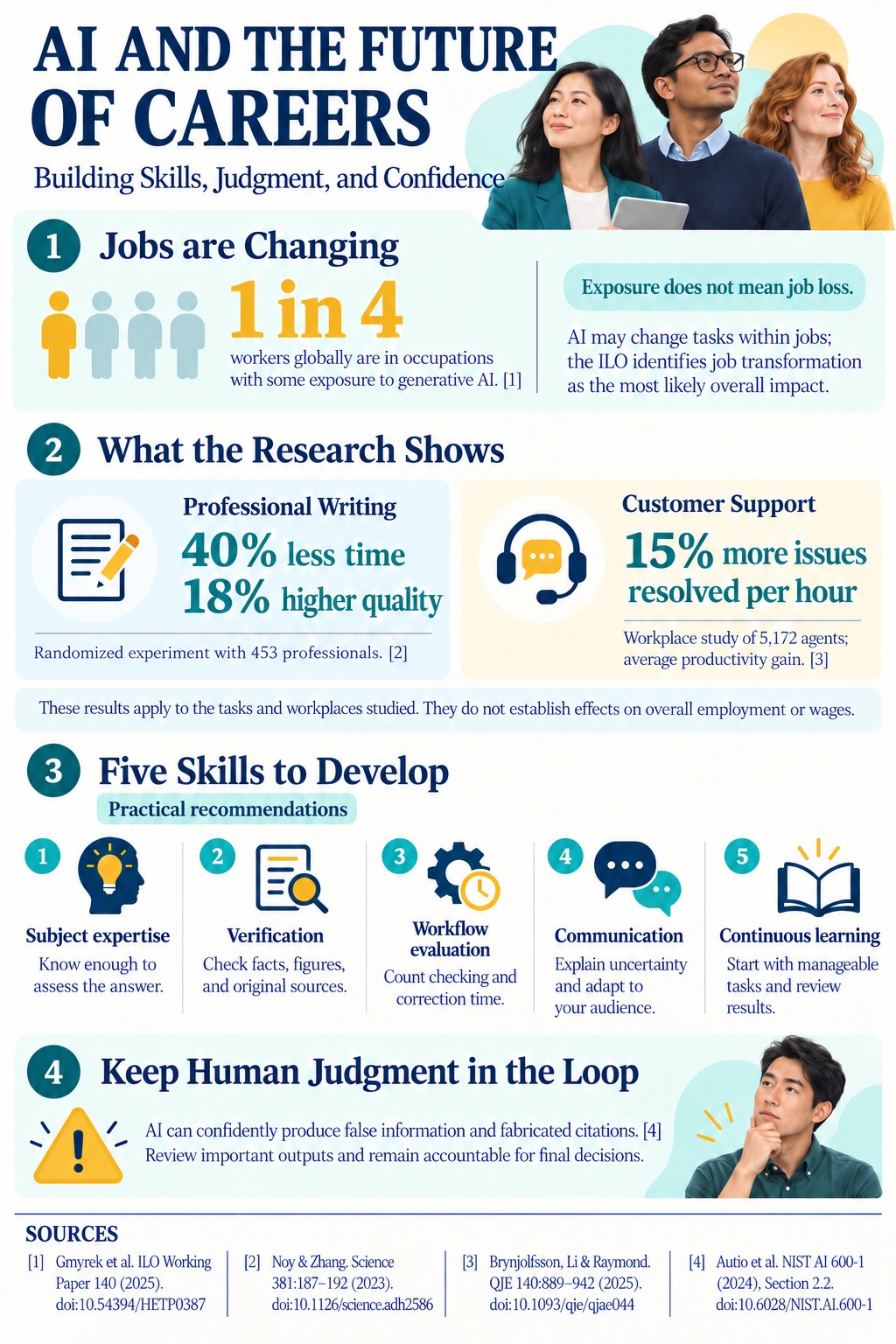
The International Labour Organization’s 2025 assessment estimates that approximately one in four workers globally is employed in an occupation with some exposure to generative AI. Clerical occupations have the highest exposure, while some professional and technical occupations are also increasingly exposed [1].
However, exposure refers to the potential for AI to perform tasks within an occupation. It does not mean that one in four workers will lose their jobs. Because occupations combine different activities, many of which require human input, the ILO identifies job transformation as the most likely overall outcome [1].
For career planning, this suggests a useful starting point: examine the activities within a job. Preparing an initial document, checking its accuracy, discussing its implications, and taking responsibility for a decision involve different capabilities. AI may support some of these activities more effectively than others.
What Research Shows About Productivity
In a randomized experiment involving 453 college-educated professionals, Noy and Zhang examined the use of ChatGPT for professional writing tasks. Participants given access to the tool completed tasks in approximately 40% less time, while assessed output quality increased by 18% [2]. These findings demonstrate benefits for the writing activities studied; they do not establish equivalent improvements across all professional responsibilities.
Evidence from an actual workplace also shows uneven benefits. A study of 5,172 customer-support agents found that access to an AI assistant increased issues resolved per hour by 15% on average. Less experienced and lower-skilled workers benefited most. The most experienced and highest-skilled workers experienced smaller improvements in speed and small declines in quality [3]. The study did not establish effects on overall employment or wages.
Together, these studies suggest that effective AI use requires selecting suitable tasks and evaluating results. Access to a tool alone does not guarantee better performance.
Why Professional Judgment Matters
An AI-generated answer can sound convincing while containing errors. The US National Institute of Standards and Technology describes this risk as “confabulation,” including confidently presented false information and fabricated citations [4, Section 2.2].
The practical implication is that AI-assisted work requires verification. References must exist, statistics must match their sources, and conclusions must be supported by the available evidence.
For example, an AI-generated summary of a survey might present an association as a causal relationship or overlook limitations in the sample. A polished business report might contain an unsupported market estimate. Recognizing such problems requires knowledge of the subject and an understanding of how the information was produced.
Preparing for Changing Careers
The following recommendations translate this evidence into practical steps.
- Strengthen subject expertise. Understanding your field provides the foundation for evaluating AI-generated work. Continue developing the knowledge needed to recognize errors, assess relevance, and make informed decisions.
- Practise verification. Check important claims against original publications, datasets, or official documents. Treat generated references as information to verify before using them.
- Evaluate the complete workflow. Consider the time spent checking and correcting an output alongside the time saved producing it. A useful tool should improve the overall process and the quality of the final result.
- Develop communication skills. Practise explaining uncertainty, listening to others, and adapting information to different audiences. These abilities help turn information into decisions that people can understand and act upon.
- Learn through manageable tasks. Begin with activities whose accuracy you can assess. Compare AI-assisted results with your usual work, identify recurring problems, and expand your use as your competence grows.
Employers and education providers can support this learning through practical training, opportunities to discuss mistakes, and clear responsibility for reviewing final outputs. These are recommendations for applying the evidence, rather than findings directly tested across all workplaces.
As AI changes professional tasks, career preparation should combine practical AI skills with subject expertise, critical thinking, and communication. The ability to assess an output, recognize its limitations, and take responsibility for a final decision remains essential.
References
- Gmyrek P, Berg J, Kamiński K, et al. Generative AI and Jobs: A Refined Global Index of Occupational Exposure. ILO Working Paper 140. International Labour Organization; 2025. doi:10.54394/HETP0387.
- Noy S, Zhang W. Experimental evidence on the productivity effects of generative artificial intelligence. Science. 2023;381(6654):187–192. doi:10.1126/science.adh2586.
- Brynjolfsson E, Li D, Raymond L. Generative AI at work. The Quarterly Journal of Economics. 2025;140(2):889–942. doi:10.1093/qje/qjae044.
- Autio C, Schwartz R, Dunietz J, et al. Artificial Intelligence Risk Management Framework: Generative Artificial Intelligence Profile. NIST AI 600-1. National Institute of Standards and Technology; 2024. Section 2.2: Confabulation. doi:10.6028/NIST.AI.600-1.